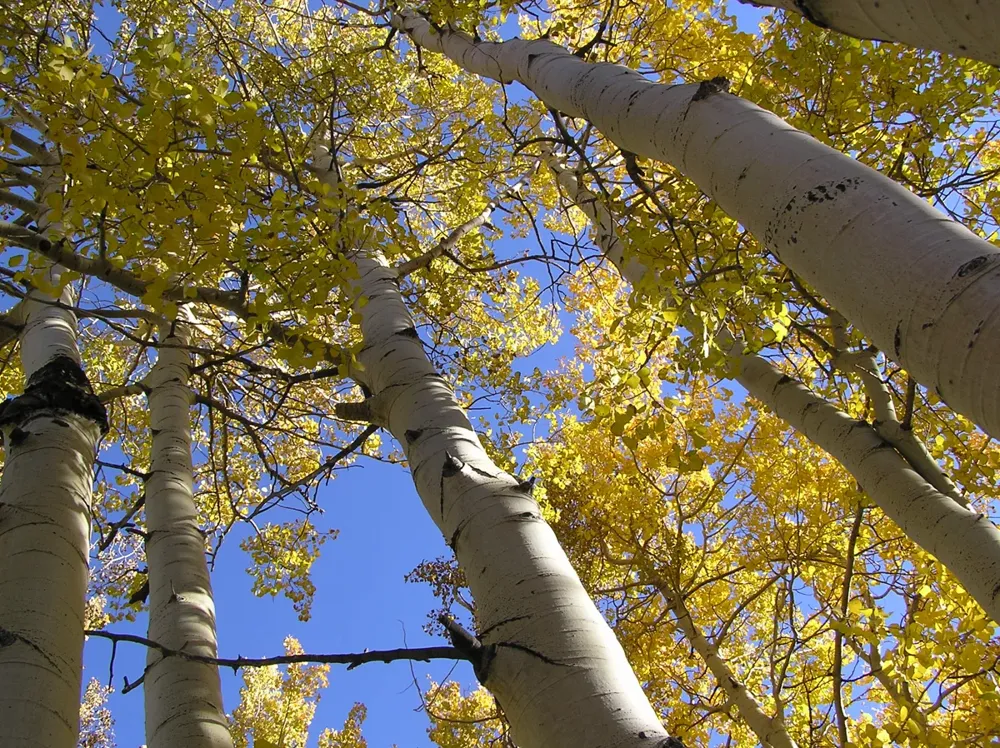
Quaking aspen
Utah's state tree forms bright mountain groves whose separate trunks can share an underground root system.
Help Utahns understand their communities and hold government accountable. Through nonpartisan, AI-assisted research, we examine public records, follow decisions and votes, and connect readers with local news, events and places.
Everything Utah, every day.
A mountain landscape contains more than one kind of habitat.
A mountain landscape contains more than one kind of habitat. At Cedar Breaks, spruce-fir woodland and subalpine meadows share the plateau, while wetter places support another set of communities. NPS describes a short, cool summer and a midsummer wildflower peak. That is a useful regional example, not a calendar for every Utah mountain. Looking from the trail, compare the shelter beneath conifers with the exposed meadow and the damp edge of a drainage.
The profiles below cover the forest side of this country: aspen, limber pine, Douglas-fir and white fir, plus Engelmann spruce at the cold, wet top of the range. The American pika belongs with the rocky slopes rather than the trees, and a forest is no promise of seeing one. Trail access and snow conditions are a separate question from the seasonal biology, so check them with the land manager before you go.

Utah's state tree forms bright mountain groves whose separate trunks can share an underground root system.
A slow-growing native pine of harsh mountain sites, with five needles in each bundle.
A native mountain conifer whose hanging cones have distinctive three-pointed bracts.
A high-country evergreen of cool, moist forest, recognized by single needles, scaly bark, and small hanging cones.
A small rabbit relative that gathers plants among mountain rocks and stays active beneath winter snow.