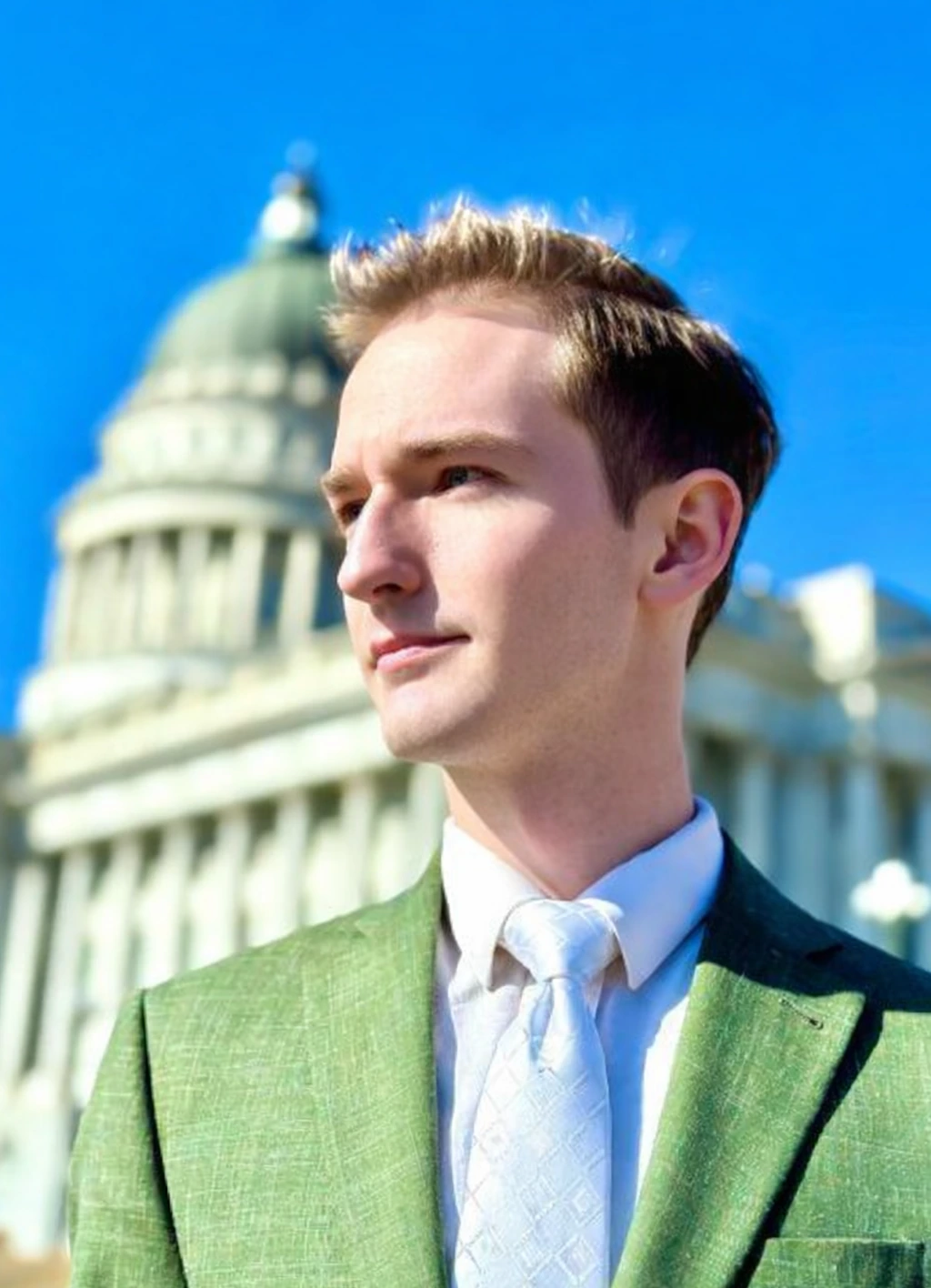
Campaign portrait. Photo: Elias Montgomery campaign (photographer uncredited) · Copyright retained by rights holder · Elias Montgomery campaign website
Campaign portrait. Photo: Elias Montgomery campaign (photographer uncredited) · Copyright retained by rights holder · Elias Montgomery campaign website
Politically neutral. Every candidate on this ballot gets the same sections. The party shown is the one the ballot lists. A section is missing only where we haven't yet found an official source for it. How we stay neutral
Elias Henry Montgomery is a candidate for U.S. House, District 1. The ballot lists Elias Henry Montgomery, Unaffiliated. The district covers all or part of Salt Lake County.
The state lists Elias Henry Montgomery as an Unaffiliated general-election candidate for Utah's 1st Congressional District. He is seeking a U.S. House seat in the November 3 election. [1]
His campaign presents him as an independent alternative to the major parties. It links affordability to political competition, arguing that corporate influence and institutional rules can raise costs while narrowing voters' choices. [2]
Housing and household costs
Montgomery favors owner-occupants over large institutional buyers of single-family houses. He calls for easier approval of duplexes, townhomes and small apartment buildings, often called missing-middle housing, to expand options accessible to ordinary wages. [2]
His platform also proposes energy-efficiency, water-resilience and transit investment to lower long-term household expenses. He favors local decisions accompanied by protections for equal rights and due process. These are campaign proposals, not changes already enacted. [2]
Election and governance proposals
Montgomery proposes independent redistricting and tying parties' nominations to statewide voter affiliation. His website presents those ideas as ways to broaden competition and reduce partisan control. They describe his agenda, rather than an adopted electoral rule. [2]
Experience and the office sought
His published platform gives more detail about policy than about education or employment. A degree, occupation or record of prior office could not be established from those sources. [2]
The office he seeks is federal. U.S. representatives serve two-year terms and represent congressional districts. His housing and local-control proposals should be read in that context: a campaign platform is not itself a change to local development rules or the electoral system. [3]
The Salt Lake Tribune's October 12 District 1 questionnaire lists Montgomery with no responses: he did not answer it, and the article does not give his occupation. His website and BallotReady describe his goals as lowering prices and ensuring government accountability. The state's declaration of candidacy is a scanned image, and this profile does not reproduce personal contact details from it. [5] [6] [4]
Health care, taxes and spending
Beyond housing and election rules, Montgomery's campaign website lists a health-care plan to pass what it calls a universal catastrophic floor, meant to shield families from medical bankruptcy. BallotReady's summary of his positions adds a pledge to outlaw surprise billing and require monopolies to publish upfront prices. [2] [6]
On taxes, the site proposes ending federal income taxation of individuals over a locked 10-year period and having the federal government run on uniform dues paid by the states. These are campaign proposals; a change of that scale would need action by Congress and the states, and none has been adopted. [2]
Energy and water
The campaign site calls for transparent energy development, blocking what it describes as closed-door corporate infrastructure deals and cutting local clean-energy permitting red tape. For water, it proposes tying state infrastructure funding to measurable, objective Great Salt Lake refilling benchmarks. [2]
Health care, taxes and federal spending
On health care, his campaign site proposes a universal catastrophic-coverage floor, keeping the federal EMTALA emergency-care requirement, upfront price disclosure by hospitals and clinics, and faster approval of generic drugs. It would limit long-term, non-emergency public care subsidies to lawful residents. [2]
On taxes, the site proposes ending the federal income tax on individuals over a 10-year period, with states instead paying the federal government dues set as a fixed percentage of each state's gross domestic product. It also proposes an algorithmic growth cap on the Federal Reserve, a single-subject rule for spending bills, and a public online tracker for federal transactions over $25,000. These are campaign proposals, and several would require constitutional or major statutory changes. [2]
He also proposes a fee on large commercial platforms in proportion to how much they use public legal, shipping and financial systems, and lower taxes on personal work and primary homes. [2]
Abortion, education and civil rights
On abortion, his site says he opposes both a criminal ban and the framing of either side of the debate. It describes an ideal of reducing abortion through support rather than law, and lists prenatal care, simpler parental leave rules, foster care and adoption networks, and permanent legal exceptions for medical emergencies, rape, incest and maternal health risks. [2]
On education, the site calls for a core curriculum focused on math, science, reading, history and civics, online portals where parents can review lessons, textbooks and library catalogs, school-library decisions tied to stated age-appropriateness criteria rather than viewpoint review, and a wind-down of the federal Department of Education's role. [2]
On LGBTQ+ rights and religious liberty, he proposes statutory guarantees that houses of worship control their own doctrines and consistent housing and employment non-discrimination protections based on identity. [2]
Guns, policing and immigration
On firearms, the site opposes bans, buybacks and registries. It proposes barring banks and data brokers from using merchant category codes to track lawful gun purchases, faster appeals for background-check errors, more community mental health resources and voluntary off-site storage, and prosecution aimed at violent felons and straw purchasers. [2]
On policing, he proposes funding for officer training, mental health resources and retention pay, together with uniform body-camera use and independent citizen oversight boards. [2]
On immigration, the site proposes more screening technology and staff at ports of entry, faster background checks for legal applicants, and annual labor-visa limits adjusted to workforce shortages. On enforcement, it would focus federal resources on cartels and violent offenders and oppose federal mandates that push local police into civil immigration checks. [2]
Environment, energy and technology
On energy and climate, his site favors cutting federal red tape for small-scale nuclear and solar projects, holding polluters liable for cleanup costs, and public environmental hearings. It says he opposes the Box Elder County data center. [2]
On air, water and public space, he supports the Rio Grande Plan to move downtown rail underground, tying state infrastructure funding to measurable Great Salt Lake refilling goals, and requiring local utility hearings before federal energy grants go to data centers. [2]
On technology, he proposes bans on automated facial recognition and license-plate tracking in public places by government agencies, treating personal data as private property that needs consent to collect, and barring agencies from buying phone-tracking data from brokers instead of obtaining warrants. [2]
Profile sources
Profile refreshed October 26, 2026. Candidate statements describe the candidate's own experience or positions; official records and reporting are labeled separately.
As a fellow SLC resident, I know the gravity of the hardships we face; housing cost, healthcare, rights and security, and much more. Partisan politics has torn America, and it has torn your paycheck, your quality of life, and threatens your safety with a false promise of security. Electing a Democrat over a Republican (or vice versa) will not change that. My promise is to prioritize Utahns, and call out the partisan malice. We need change. Here it is.
A 2018 ballot initiative, a court fight that began in 2022 and a failed repeal drive produced the map Utah votes under on Nov. 3, including a Salt Lake County district that leans Democratic.