The Great Salt Lake's long decline, explained
After a record-dry winter, the lake sits about a foot above its 2022 record low, and the state is relying on conservation, water leasing and a causeway berm to hold the line.
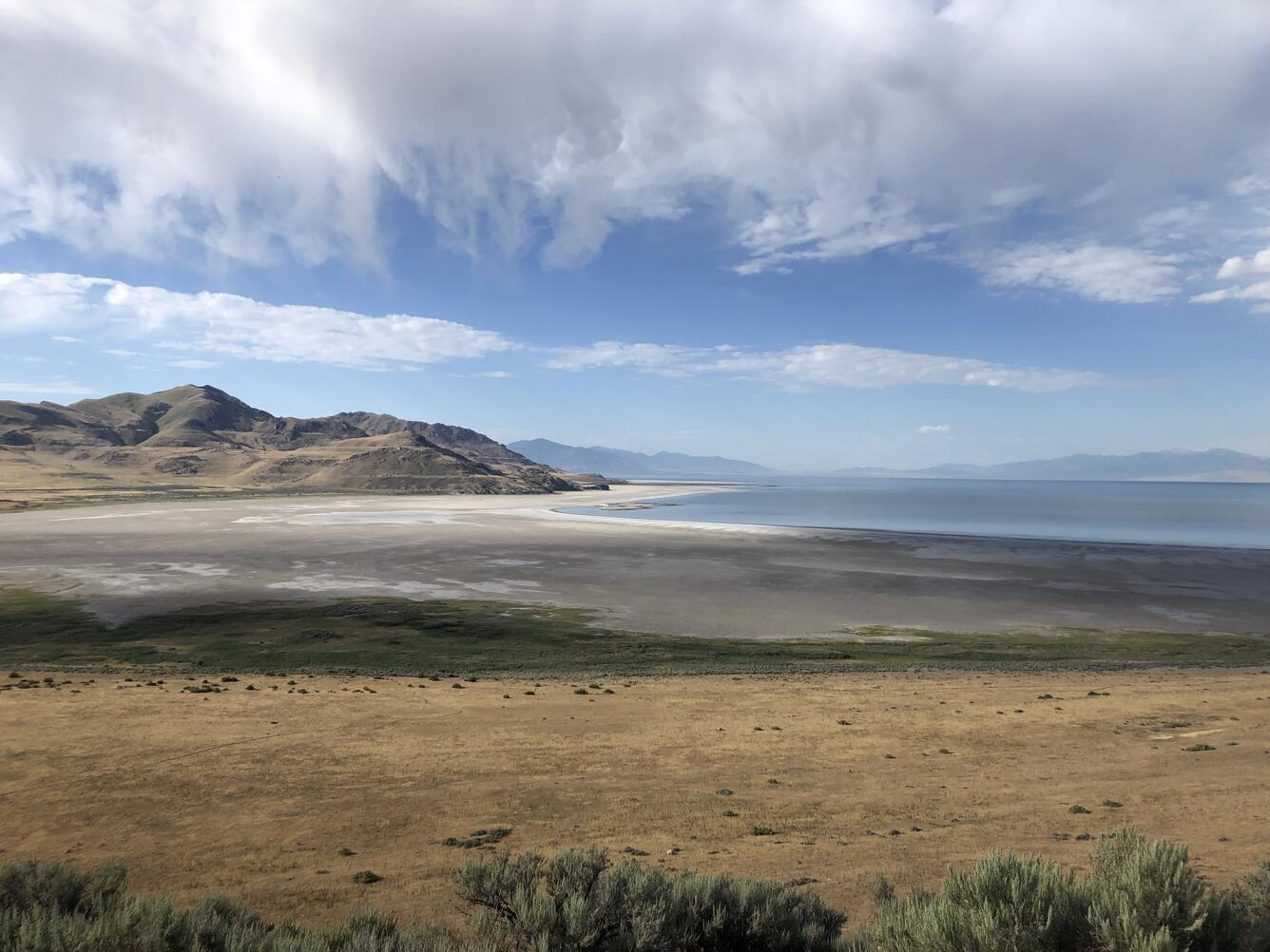
Continuing story: Saving the Great Salt Lake
The Great Salt Lake measured 4,189.8 feet above sea level in its south arm and 4,189.7 feet in its north arm on Oct. 14, 2026, according to the Utah Division of Water Resources, which draws the readings from U.S. Geological Survey gauges. The agency notes that recent readings are provisional. [1]
That is about 1.3 feet above the lake's all-time low of 4,188.5 feet, set in November 2022. Researchers and state leaders treat 4,198 feet as the lake's minimum healthy level, a mark it has not reached since 2012. [2]
A shrinking lake exposes lakebed that can send dust into the air, and Farmington Bay, a major dust hotspot, has been largely exposed since the early 2000s. Low water also makes the lake saltier: in 2022, salinity reached 183 grams per liter at Saltair and 185 grams per liter in Gilbert Bay, the south arm's main body. [2][3]
How it got here
2022: As the lake fell to its record low, the state began raising a berm in the railroad causeway that divides the north and south arms. A protocol later called for raising it when the south arm drops to 4,190 feet. [3]
2024: The lake rebounded to 4,195.2 feet. [3]
Oct. 6, 2025: In a special session, the Legislature unanimously passed HB1001, sponsored by Rep. Jill Koford, R-Ogden. It lets the Division of Forestry, Fire and State Lands raise the berm as high as 4,192 feet, after consulting the Office of the Great Salt Lake Commissioner, and requires a schedule to lower it within 18 months. Lawmakers approved $500,000 for berm management. [3]
Jan. 8, 2026: The Great Salt Lake Strike Team, more than 40 experts from Utah State University, the University of Utah and state agencies, released its 2026 Data and Insights Summary. It reported measurable progress in slowing the lake's decline, a better understanding of dust risks and refined accounting of human water use. [4]
Winter 2025-26: Utah had a record-dry winter. By mid-August 2026, the lake stood at 4,190.40 feet, inches above its 2021 low. [2]
Where it stands
In August, Joel Ferry, who leads the Utah Department of Natural Resources, said he did not expect a new record low in 2026 but called one in 2027 "unavoidable" if Utah gets another winter like the last. [2]
Ferry said the state would close the causeway berm when the lake reaches 4,190 feet and would bar mineral companies from taking new water until the lake rises back above that mark the next spring. The state also plans to lease water aggressively, including by paying farmers, and local districts may cut secondary-water use. The lake has since dropped below 4,190 feet in both arms; the sources reviewed for this explainer do not confirm whether the berm has been closed. [1][2]
Salinity in the south arm is now almost 13%, Ferry said, and is not expected to return to the nearly 19% seen at the 2022 low. [2]
BYU professor Ben Abbott, who works with the group Grow the Flow, said conservation is delivering about 50,000 to 80,000 acre-feet a year, while about 1 million acre-feet a year would be needed to reach 4,198 feet by 2034, the state's goal. [2]
What to watch
This winter's snowpack, which will largely decide whether the lake sets a new low in 2027. [2]
Berm operations and the lowering schedule required by HB1001. [3]
Water leasing deals and limits on mineral companies while the lake is low. [2]
Proposed data centers, which have become a flashpoint; many respondents to a recent Utah State University survey cited water and the lake as concerns. [5]
Sources
- Utah Division of Water Resources · Great Salt Lake elevation
- Utah News Dispatch (KSL) · Great Salt Lake not expected to hit new low in 2026, but what if it does in the future? (Aug. 16, 2026)
- Utah News Dispatch (KSL) · Utah lawmakers pass bill to raise Great Salt Lake berm during special session (Oct. 7, 2025)
- Utah State University · Great Salt Lake Strike Team releases 2026 summary (Jan. 8, 2026)
- The Salt Lake Tribune · Most Utahns oppose building more data centers (Oct. 8, 2026)
Background explainer by The Utah Ledger. AI-assisted reporting, checked against the sources above.